Two Sports, Two Selves

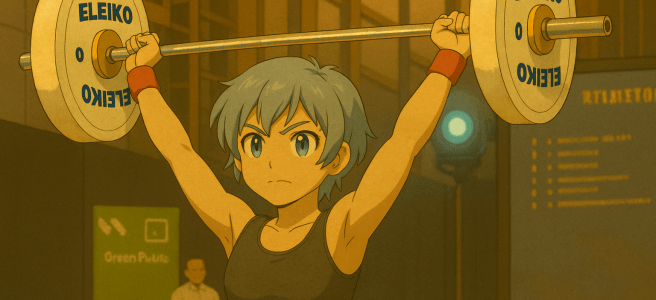
The training hall was filled with the clank of plates being loaded and unloaded. I sat alone on the floor, preparing my warm-up.  Around me, other lifters started moving in. They are followed by their coaches, teammates, and friends, etc. They were there to help the lifters time the lifts, to film their attempts for social media, and to offer encouragement. They were not teenage prodigies. These were grown-ups. Middle-aged recreational lifters at the British Weightlifting Master’s Championship.

I couldn’t help but wonder. Don’t they have anything else to do on the day? So, who’s paying for all this?

As I watched the entourages, a familiar ache settled in my stomach. A little gremlin perched on my shoulder and whispered.    

Look at you, sitting alone again. Because you are hopeless.

The Tale of Two Worlds

I am in two sports that exist in a completely different universe.  I have become a different version of myself in each. One is running, and the other is Olympic Lifting.

Running is open. Inclusive. You can turn up to a Parkrun in a cotton T-shirt and baggy trousers, and no one will blink. Entry is free. People of all ages, shapes, and speeds show up. It is not about competing or showing off. It is all about turning up and doing your best. And most important of all, is to have a good time.

I didn’t buy my way into the running. I just ran. And ran. Because that was all I wanted to do. Running found me. Running gave me a space where I belonged. In that space, we are in the same tribe. I am happiest when I’m with my tribe.

Weightlifting, on the other hand, demands payment for entry.

The more I got into this sport, the more I saw how hard it is for others to even start. The gym memberships alone can cost £100+ per month for facilities with proper Olympic lifting platforms. Quality coaching runs £50-80 per session. The equipment that most people have never even touched requires instruction to use safely.

Olympic lifting bars start at 15kg or 20kg before adding any plates. The “light” 15kg bars are made for smaller hands, but they’re still heavy — especially when paired with 5kg bumper plates on each side. That’s a 25kg starting weight. Not something an average 50-year-old woman can just pick up on day one and start training on her own. This isn’t the council gym’s BodyPump class.

To get properly equipped and coached from scratch? You’re looking at £200-300 per month, minimum. That is, before you’ve even lifted a single weight in competition.

The Myth of Inclusion

“Weightlifting is for everyone,” they say. “We’re so inclusive.”

But wait. Look closer. Is it? Really?

There’s a quiet assumption that everyone starts from a place of access. There is an expectation of strength and mobility — in other words, you are assumed to be young and fit. And there’s something more. Something more systemic.

I come from an ultra-trail running background, where external support is often banned during races to ensure fairness. In ultra-trail running, support crews are considered a competitive advantage and thus unfair. In weightlifting, they’re not just allowed — they’re expected. 

The Ghost of a Family Script

Let me explain why this bothers me so much.

I have a sister who is three years older. We both did music, dance, and sports growing up. But when we both got to the university level, things started to change. My sister was the one with the talent. The one my parents poured all their energy and resources into.

“We can’t afford two kids doing art,” they said. “Do something useful. Earn a living.”, they said.

By that time, I had a resident gremlin on my shoulder 24/7 whispering into my ears.

Because you are hopeless.  You haven’t got talent.  You are not worthy of investment.  

So, while my sister studied music in Europe, I worked multiple jobs to fund my gap year trip to America. When she sang in the state opera house in Germany, I worked in a bank, paying bills. When I finally got my first bonus, I joined the studio and resumed dance as a hobby.

When I saw these lifters with the entourages that day, I thought of my sister. I thought of my sister with my parents, who were carrying her bags, taking photos, showering her with encouragement, and telling her how amazing she was. And I thought of all the people who never even got the chance — priced out of the sport, the support, and the spotlight.

When Passion Isn’t Enough

Weightlifting is a skill-based sport. You need mobility, strength and technique. You need all three. And you need time, coaching, and access.

If you’re working full-time, just getting to a suitable gym can be a logistical challenge. Many of the best-equipped gyms are either prohibitively expensive or overcrowded during peak hours.  And even when you do manage to show up, you still need someone to show you how to lift safely. Or, even if you are an advanced lifter, you still need constant coaching so that you don’t fall into bad habits. Those bad habits could stifle the improvement or lead to an injury.

Injuries in this sport are very common. But they aren’t always the athlete’s fault. Often, they’re the result of poor coaching or being left to figure it out alone. And when that happens, people leave quietly. The sport moves on. There’s always a constant stream of young, fit, affluent lifters ready to fill your place. You only need to look at social media to see who has taken your place.

Giving Myself Permission

I spent 35 years in banking — long hours, little time for myself. I chose the gym based on its location. The closer to my desk at the office, the better. The weightlifting gym with specialist equipment wasn’t even on my radar, let alone coaching packages. I just didn’t have the time to commit to either. I didn’t have the luxury of dreaming about my sporting potential beyond my day job.

What if someone had believed in my potential? Did I have potential? Would my life have been any different? What if I’d believed in myself sooner?

At 58, when I left full-time employment, I decided to stop wondering. Life is too short. I decided to give myself the privilege I never had before — to train as much as I wanted, to prioritise my health and wellness, to invest in a version of myself I’d never had a chance to grow into.

Most people don’t get to do this at my age. I know that. And I don’t take this privilege for granted.

Standing Tall

Back at the British Weightlifting Master’s Championship, I won the title in the 48kg class. I stood awkwardly on the podium, gold medal around my neck, and felt… nothing like a champion.

The little gremlin asked.

So, you think you’ve proven something? That you’re worth it now?

I am working on it. Not by training more, but by learning how to stand tall beside that voice. Learning to recognise when he speaks and choosing not to argue. But not to let him win either.

Some days, standing tall looks like showing up to compete. Other days, it’s celebrating a personal best. Most days, it’s simply remembering that I chose to be here.

At 60, I am lifting heavier than I ever imagined possible, in a sport that tried to escort me out before I even started.

The gremlin can stay on my shoulder. But he doesn’t get to drive me anywhere anymore.
Learn to Fly – From Trail to 190 Miles

In late 2015, I was in a cafe in Chamonix, relaxing after a day of ski touring through the mountains. One of the guys on the trip showed me the advertisement for the inaugural Northern Traverse race on Facebook, and he called the race director, James Thurlow, one of the best in the ultra-running community.

Since my first marathon in April 2013, I had been bitten by the long-distance running bug, and I went on to complete another couple of marathons, as well as a 100k trail race, in the same year. Then, one race led to another. I’d done dozens of trail races with ultra distances, including 100 miles in the Lake District by the latter half of 2015. So, the 190-mile race from Cumbria to the North York Moors felt like a natural progression.

And I liked the idea of doing a race that no one had done before and was organized by the best of all the race directors.

Preparing (or Not)

I bought a guidebook called Coast to Coast Path after a friend recommended it. But when it arrived, thick and dense, I felt overwhelmed. It ended up unread, tucked at the back of the bookshelf.  I had a full-time job in banking, and I didn’t have time for that sort of thing.  The route looked like a straight line from the West end to the East end in North England, so it should not be too difficult to navigate.  If in any doubt, head East – right?   

In short, I did very little to prepare for the race.   

Race Plan (Sort of)

The race director provided 4 checkpoints, which were roughly 40 miles apart.  I made a loose plan for arrival times and rest breaks as follows:  

  • Checkpoint 1 – Patterdale: I aim to arrive at 11pm. If we are to start at 10am, taking 13 hours to cover all Cumbrian fells in the stretch of 40 miles seemed reasonable. I do not need to sleep there.  I only need 1.5 hours to eat and sort myself. 
  • Checkpoint 2 – Kirkby Stephen: Arrival sometime late morning or early afternoon. It would be daylight, but I planned to sleep for at least an hour.
  • Checkpoint 3 – Richmond: Arrival in the morning after two nights of continuous running. It is gonna be hard.  My plan was to sleep for at least 2 hours.
  • Checkpoint 4 – Lion Inn (North York Moors): If I made it there, I’d celebrate. I’d rest as much as needed. 
  • Finish – Robin Hood’s Bay:  Let’s get there in daylight.  Come on, Hisayo, you can do it. 

Let’s get started….  St. Bees to Patterdale (Leg 1/5)

After all the excitement of registration and the group photo at the start line, we all joyfully started like one big family.  We were all chatting and running together, no one was entirely sure how we, or any of us, would actually make it to the end.  I found myself running side by side with a friendly man who suggested sticking together for mutual support.  I knew it. This idea rarely works in a long-distance race. But, for whatever reason, I was too polite to tell him to leave me alone.  Unsurprisingly, by mile 20, this “helping each other” idea started to collapse. He started to straggle – in a big way.  

I am a slow burner who can sustain a medium to low energy for a very long period, which is quite typical for a female ultra runner.  I have seen many male runners burn out too quickly and drop out before the finish.    

I could have just said something like “‘Twas nice meeting you, good luck and see you later” and run off.  But by that time, I was carrying his snacks and route notes.  I felt responsible, and I couldn’t find the politest way to move on.  He started to blame me for going too fast, insisted I rest, and got increasingly irritated when I didn’t.  I saw myself falling into old patterns—putting someone else’s comfort before my own. 

Memories of a past abusive relationship bubbled up in my head.  

I stopped and waited, and stopped and waited.  He was so tired and had to find a reason to rest every five minutes. He wanted to climb the hill first to stop me from climbing ahead of him. I let him go first and waited behind him.  Little pieces of stones and gravels fell on my head as he struggled to plant his feet on the uphill. It was getting dark, and the sun was settling in.  His language was getting abusive. When I finally heard the “F” word thrown at me, I decided it was time.  We were in the middle of the mountain path, and it was pitch dark. I sprang to my feet and ran off.  I did not look back. 

I arrived at the first checkpoint at 1.30 am—2.5 hours behind my most conservative plan. My name was at the bottom of the women’s leaderboard. My heart sank.

Sick as a dog…  Patterdale to Kirkby Stephen (Leg 2/5)

I cleared my head.  I was finally on my own.  It felt like my race finally started.  I reached the top of the mountain, the sun was rising on the horizon, and the clouds were moving along.  Beautiful, but freezing.  The wind was so strong, and I clung on to my jacket and other stuff so that they wouldn’t get blown off.  Then, I was getting sick.  I couldn’t stop hiccuping and wanted to vomit.  

My thought was to descend as quickly as possible so that I could vomit at the bottom of the mountain.  That way, I would sit and rest at a safe place.  It was a very steep descent, and the ground was wet and loose. My foot slipped and I lost balance. Before I knew it, my body was slammed down on the hard surface. I lay where my body ended up, looking at the clouds in the sky.  I didn’t vomit though. My stomach was empty.  I just had a bit of stomach acid coming out of my mouth.  My head hurt. I might have hit the back of my head. 

Get up, Hisayo.  Move, Hisayo.  Run. 

The sun was up, and it got warm.  I ran through the open field and to the cattle field to the second checkpoint.   

I slid myself into the sleeping bag in the pop-up tent at the second checkpoint for 1.5 hours of sleep.  One of the girls in the race saw me and proclaimed that I was the first lady in the race.  My head was blurred, and I was still dreaming.    

Dark night, fogs, bogs, and sleep deprivation…  Kirkby Stephen to Richmond (Leg 3/5)

I left the indoor comfort of the checkpoint and headed back out to the trail again.  Head East through Nine Standards Rigg.  It was getting dark again, and the fog was descending in a mist. The piles of rocks appeared in the midst of nowhere in front of me.   It was as if some god-like creature was standing in front of me.  

My feet were buried deep in the knee-deep bogs, and taking one step after another was hard enough.  My knees were constantly hitting the surface of the bogs, and I was almost on fours, hands and knees.  

I started to hear the voices of people chatting and laughing.  It sounded like some people were having a good time somewhere.  I saw some armed terrorists duck down in the bushes, watching my move.  The sheep were laughing at me, then they turned into white rocks.  I saw a cat lying ahead of me. Then, she turned into a rabbit and ran away.  

I was pretty sure that there was a footbridge on the map. I stood in front of a large stream running through the bottom of the hills.  The footbridge was gone. How could this happen? No footbridge over the stream. The footbridge was 5 metres to my left, but I just didn’t see it in the darkness.  

With no footbridge available, I went straight down to cross the stream. The cold water went up to my knees.  It was slippery and I fell.  I landed with my bum, and I cut my palm on the sharp rock.  A warm blood streamed down.  As I fumbled with my rucksack to get a plaster out, the whole damn thing dropped into the water. All my plasters were wet and ruined.  I licked the wound to stop the blood flow.  The blood was everywhere on my shirt.  Damn Damn Damn, you stupid woman!!   

Calm down, Hisayo.  Move on.  Run.

I spent the whole night moving through the hills and reached the village of Reeth at dawn.  I lay underneath the bus shelter and rested my eyes for 10 minutes.  The flat concrete surface in the bus shelter felt like the nicest thing in the world.   

Arriving in the town of Richmond, I hobbled through the street to find the village hall – the third checkpoint.  I heard the woman’s voice from one of the windows in the flat building above.  “OH MY GOD, she is coming, she is coming!!  The first lady is coming through!!!  Go Hisayo, Run!!!”.  

At the checkpoint, I was offered homemade, delicious-looking lasagna. I took two portions and ate them all at once. I slept for two hours in the pop-up tent.

Sore feet and hallucination… Richmond to North York Moors (Leg 4/5)

I was in serious pain.  Both of my big toes were swollen up with toenails coming off the skin, and the third and fourth toes were cojoined by mud and blood.  The skin on the balls of my feet had peeled off.  I felt like walking on the shattered glass every time my foot touched the ground.  

Then, the night fell on me again.  Cold, wet, and windy.  I was so tired and sleepy.  

As I was climbing the hill, the path looked like it was covered in snow.  I thought this can’t be right – this is England….  The rocks kept moving, and I couldn’t work out where to plant my feet.  I then started falling sideways as my left foot was landing on the right side of my right foot, and my right foot was landing on the left side of my left foot.  I saw a policeman in the bush, but when I tried to ask him for help, he vanished.  I started hearing the voices and chattering.  On the side of the path, I saw a window in a residential house that was brightly lit, and big rabbits wearing tuxedos were having a party.  I looked back to see the large object that had been following me for some time. A tiger was riding on a large whale.  

I was just too tired.  I hadn’t had anything to drink for god knows how long.  My throat was burning.  I thought of maybe using my arms to move forward.   

As I hobbled my way through, the path started swinging left, right, left and right.  I was losing my peripheral vision, and that narrow path suddenly rose up with a bang sound and hit my forehead.   

Get up, Hisayo.  Move, Hisayo.  Run.  

Finally, at the fourth checkpoint.  A man with a few words asked me.  

‘Hisayo, do you want water?’  I nod.  I can do that whole jag please. 

‘Any food?’  I shook my head. Not hungry. I am sick. ‘Have some porridge here.’  I forced down the pot of porridge.  A pile of pebbles landed on my acid-filled, empty stomach.   

‘You are 5 hours ahead of the second lady. You could win this.’

I lay down in the pop-up tent.  My body was shattered into pieces.  As I was falling unconscious, I wondered if I could ever get up again. 

Learn to fly…  North York Moor to Robin Hood’s Bay (Leg 5/5)

I don’t remember how many hours I was lying there.  I woke up as I could see the light through the thin layer of the pop-up tent.  It was time to go again.  

I had just 20 miles to the finish.  Less than a marathon. Easy, right?

I tidied up my rucksack and dry bags for one last time.  

I could see the daylight shining on the horizon.  The ground underneath was very soft and kind to my battered feet.  There was not one person ahead, behind or beside me.  In the vast open moorland, it was just me, the trail, the horizon and the sun. 

Then, I saw the sunset.  The sky was crimson, and the sun was descending to the horizon.  I could see the long path leading me to the East. 

Run. Hisayo. Run.   

I no longer had pain.  My head was crystal clear.  I wasn’t running.  I was flying.  

I reached Robin Hood’s Bay at 2am Friday morning, 88 hours after I started, as the second lady in the race.

I lay on the floor of the village hall, both feet up on the chair, and passed out.  In my dream-like memory, I remembered the big smiles on the people’s faces coming out of the kitchen.   Then I heard someone say, “Well done, Hisayo, well done”….   

Final words

The man who gave me a hard time in the first 40 miles finished the race in 103 hours, 15 hours after I did.  I knew that he was not in any way injured when I left him. We are grown-ups, and we are all responsible for our own actions. Our paths never crossed again.    

I attempted the same race two years later, in 2018, and finished in style with 79 hours, 9 hours quicker than I had in 2016. No dramas there.  I was stronger, faster and more experienced.   

The Northern Traverse was sold to another event company, Ourea Events, when James Thurlow closed down his event business in 2021.  

The Northern Traverse wasn’t just a race or a finish line to chase. It was a crossing—and I was no longer the same person who had set out.

Just keep moving, keep going, and don’t give up. Then you’ll see what I mean. You will see what flying really is.      

Link

https://www.northerntraverse.com/northern-traverse