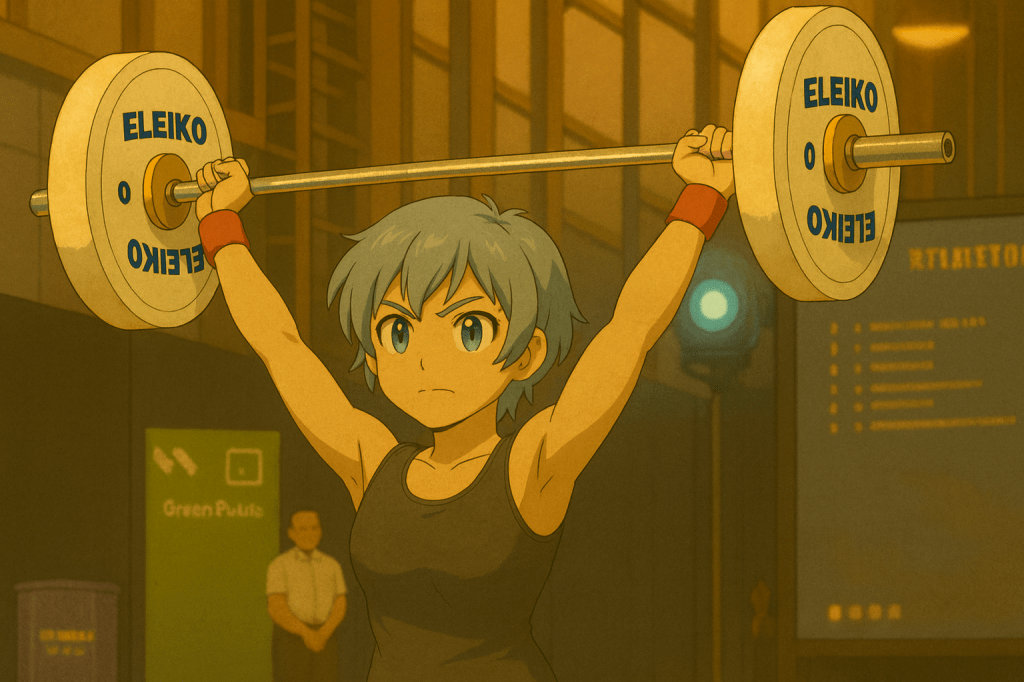
The training hall was filled with the clank of plates being loaded and unloaded. I sat alone on the floor, preparing my warm-up. Around me, other lifters started moving in. They are followed by their coaches, teammates, and friends, etc. They were there to help the lifters time the lifts, to film their attempts for social media, and to offer encouragement. They were not teenage prodigies. These were grown-ups. Middle-aged recreational lifters at the British Weightlifting Master’s Championship.
I couldn’t help but wonder. Don’t they have anything else to do on the day? So, who’s paying for all this?
As I watched the entourages, a familiar ache settled in my stomach. A little gremlin perched on my shoulder and whispered.
Look at you, sitting alone again. Because you are hopeless.
The Tale of Two Worlds
I am in two sports that exist in a completely different universe. I have become a different version of myself in each. One is running, and the other is Olympic Lifting.
Running is open. Inclusive. You can turn up to a Parkrun in a cotton T-shirt and baggy trousers, and no one will blink. Entry is free. People of all ages, shapes, and speeds show up. It is not about competing or showing off. It is all about turning up and doing your best. And most important of all, is to have a good time.
I didn’t buy my way into the running. I just ran. And ran. Because that was all I wanted to do. Running found me. Running gave me a space where I belonged. In that space, we are in the same tribe. I am happiest when I’m with my tribe.
Weightlifting, on the other hand, demands payment for entry.
The more I got into this sport, the more I saw how hard it is for others to even start. The gym memberships alone can cost £100+ per month for facilities with proper Olympic lifting platforms. Quality coaching runs £50-80 per session. The equipment that most people have never even touched requires instruction to use safely.
Olympic lifting bars start at 15kg or 20kg before adding any plates. The “light” 15kg bars are made for smaller hands, but they’re still heavy — especially when paired with 5kg bumper plates on each side. That’s a 25kg starting weight. Not something an average 50-year-old woman can just pick up on day one and start training on her own. This isn’t the council gym’s BodyPump class.
To get properly equipped and coached from scratch? You’re looking at £200-300 per month, minimum. That is, before you’ve even lifted a single weight in competition.
The Myth of Inclusion
“Weightlifting is for everyone,” they say. “We’re so inclusive.”
But wait. Look closer. Is it? Really?
There’s a quiet assumption that everyone starts from a place of access. There is an expectation of strength and mobility — in other words, you are assumed to be young and fit. And there’s something more. Something more systemic.
I come from an ultra-trail running background, where external support is often banned during races to ensure fairness. In ultra-trail running, support crews are considered a competitive advantage and thus unfair. In weightlifting, they’re not just allowed — they’re expected.
The Ghost of a Family Script
Let me explain why this bothers me so much.
I have a sister who is three years older. We both did music, dance, and sports growing up. But when we both got to the university level, things started to change. My sister was the one with the talent. The one my parents poured all their energy and resources into.
“We can’t afford two kids doing art,” they said. “Do something useful. Earn a living.”, they said.
By that time, I had a resident gremlin on my shoulder 24/7 whispering into my ears.
Because you are hopeless. You haven’t got talent. You are not worthy of investment.
So, while my sister studied music in Europe, I worked multiple jobs to fund my gap year trip to America. When she sang in the state opera house in Germany, I worked in a bank, paying bills. When I finally got my first bonus, I joined the studio and resumed dance as a hobby.
When I saw these lifters with the entourages that day, I thought of my sister. I thought of my sister with my parents, who were carrying her bags, taking photos, showering her with encouragement, and telling her how amazing she was. And I thought of all the people who never even got the chance — priced out of the sport, the support, and the spotlight.
When Passion Isn’t Enough
Weightlifting is a skill-based sport. You need mobility, strength and technique. You need all three. And you need time, coaching, and access.
If you’re working full-time, just getting to a suitable gym can be a logistical challenge. Many of the best-equipped gyms are either prohibitively expensive or overcrowded during peak hours. And even when you do manage to show up, you still need someone to show you how to lift safely. Or, even if you are an advanced lifter, you still need constant coaching so that you don’t fall into bad habits. Those bad habits could stifle the improvement or lead to an injury.
Injuries in this sport are very common. But they aren’t always the athlete’s fault. Often, they’re the result of poor coaching or being left to figure it out alone. And when that happens, people leave quietly. The sport moves on. There’s always a constant stream of young, fit, affluent lifters ready to fill your place. You only need to look at social media to see who has taken your place.
Giving Myself Permission
I spent 35 years in banking — long hours, little time for myself. I chose the gym based on its location. The closer to my desk at the office, the better. The weightlifting gym with specialist equipment wasn’t even on my radar, let alone coaching packages. I just didn’t have the time to commit to either. I didn’t have the luxury of dreaming about my sporting potential beyond my day job.
What if someone had believed in my potential? Did I have potential? Would my life have been any different? What if I’d believed in myself sooner?
At 58, when I left full-time employment, I decided to stop wondering. Life is too short. I decided to give myself the privilege I never had before — to train as much as I wanted, to prioritise my health and wellness, to invest in a version of myself I’d never had a chance to grow into.
Most people don’t get to do this at my age. I know that. And I don’t take this privilege for granted.
Standing Tall
Back at the British Weightlifting Master’s Championship, I won the title in the 48kg class. I stood awkwardly on the podium, gold medal around my neck, and felt… nothing like a champion.
The little gremlin asked.
So, you think you’ve proven something? That you’re worth it now?
I am working on it. Not by training more, but by learning how to stand tall beside that voice. Learning to recognise when he speaks and choosing not to argue. But not to let him win either.
Some days, standing tall looks like showing up to compete. Other days, it’s celebrating a personal best. Most days, it’s simply remembering that I chose to be here.
At 60, I am lifting heavier than I ever imagined possible, in a sport that tried to escort me out before I even started.
The gremlin can stay on my shoulder. But he doesn’t get to drive me anywhere anymore.
 runhisayorun