Goodbye from HSBC
In November 2018, I was made redundant from HSBC. Eight years of hard work. Long hours. A job I didn’t even like. I stood on the platform at Canary Wharf, holding a neat little divorce paper from HR. Shellshocked. I was at a loss. How dare you?
But underneath the shock, I was somewhat relieved. No more 45-minute breathers hiding in the company gym. No more soggy sandwiches and overpriced lattes. I could finally make coffee at home, cook my own lunch, and maybe—just maybe—do something meaningful for once.
I enrolled in a Pilates practitioner course. It felt like a logical next step. I’d done years of ballet and contemporary dance—core strength, mobility, body awareness, all that. Maybe I could teach runners how to move better.
Why Not Pilates?
The more I learned, the more I realised that this wasn’t it. Pilates has its place—Joseph Pilates developed the reformer Pilates to help WWI soldiers who were amputated in hospital beds. But I wasn’t bedbound. I was an ultrarunner pounding trails, absorbing forces four times my body weight with every step. Pilates wouldn’t cut it. I needed something more powerful, stronger, and heavier.
Falling in Love with That Bar
I asked a friend from the running club: “Know anyone who can teach strength training?” She gave me the contact details of a guy who had started a barbell club. I had no idea what I was getting into. I vaguely thought maybe he would teach me how to bench press. Or deadlifts. Those were the only lifts I knew. But he turned out to be an Olympic lifting specialist.
On day one, I stood with a barbell in my hands, shrugging my shoulders up and down. No idea why. Just did what I was told.
The club was an extension of the university’s barbell club. Everyone around me was in their twenties—students and recent grads. Wonderfully young and trendy with flexible joints. Meanwhile, I was a 54-year-old ultrarunner with stiff joints who couldn’t even squat below parallel. I’d never felt more miserable and out of place. And I definitely wasn’t “one of them.”
But I didn’t leave. I was intrigued. As a movement nerd who loves watching how the human body moves, I wanted to understand the mechanics. I dreamed of one day catching a snatch in a full deep squat. I watched videos. Took notes. Practised.
This Place Is Not for You
One day, I managed to secure one of the gym’s four squat racks during rush hour. I was trying to back squat when a smiling PT walked over.
“Hey, I think this is too heavy for you, you might get injured. Why don’t you come over here with me, I’ll show you some kettlebell work.”
I knew what he meant. “This is not for you. You don’t belong here, old lady.“
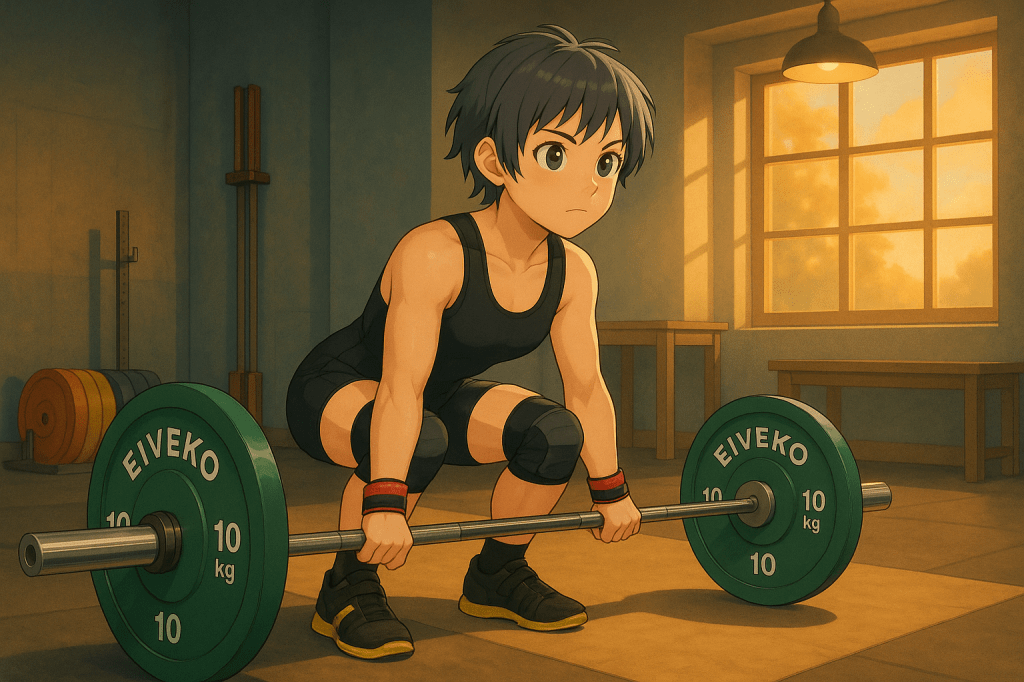
That night, I ordered my own squat rack, barbell, and bumper plates. If I wasn’t welcome there, I’d train at home.
Then COVID hit. Boris announced full lockdown, and I found myself sitting in my living room, alone with my new equipment while the world shut down. For the next two years, I trained on my own. I never went back to that gym.
Pain and Anger
During this time, I was suffering from severe back pain. My hope was to get the root cause, once and for all. I sat with the sports consultant with the MRI scan result in front of us. The consultant walked me through the results from the lab. Basically….I have degeneration in my lower spine—cartilage damage, marrow oedema, and bone fusion between L4 and L5.
“Cut your running down to 20km a week,” he said, as a matter of factly. “Stay away from explosive movements. At your age, with this kind of wear and tear, Olympic-style lifting is inappropriate. You are post-menopausal, after all.”
Then came the osteopath: “You just have osteoarthritis. This is normal for someone your age. It’s called wear and tear. There’s nothing we can do about it. But you can learn to manage the pain.”
I was furious.
I’d lived with back pain my entire life. By age 13, I had chronic back pain from gymnastics and was the youngest patient in the physio clinic. Through falling grades and sleepless nights, I’d pushed through the pain. I’d tried every pain management technique available on earth: physiotherapists, osteopaths, chiropractors, acupuncturists, Reiki practitioners. I’d learned yoga, Pilates, aqua-walking, and the Feldenkrais method. I’d always had ergonomic chairs, back rests, and sit-stand desks at work—all to manage the pain, hoping that one day it would go away.
Not one person had helped me eliminate my back pain.
And now this: Too old. Too broken. Sorry, but it’s too late.
I was absolutely furious.
I Want to Get Strong
I cancelled my appointment with the osteopath. I didn’t need another pain manager. I needed a different approach entirely. Instead, I hired a strength and conditioning coach focused on sports performance.
I have absolute faith in physical therapy. Strength is the key. “I want to get strong. Design a program for me. I want to run. I want to lift. I want to move. I’m going to train like you’ve never seen before.”
Three years later, after dozens of strength training blocks, I am stronger than I have ever been in my life. I am no longer in pain. I can now squat down to untie my shoelaces after a 20km run. Look at that. I couldn’t do that before!!
When I finally took back control of my body, everything changed.
The Lesson
Don’t accept advice from people who tell you that you’re too old or too broken. Work with people who believe you can achieve whatever you set your mind to.
Because you almost always can. It’s never too late.
Let’s challenge the norm. Together.
 runhisayorun